Wednesday, July 16, 2014

The Yew Dell Sculpture Show- really late in posting this, only 2 more weeks to see the show....

This sculpture I carved from Alabama Marble, is strapped to the knuckle-boom truck for the trip to Yew Dell Gardens for the 7th Annual Sculpture show. Her name in the show is "Lifting the Veil" but I have since renamed her for th Greek Goddess  Nyx.  She lifts her veil to look at the day and with it truth.


Mike McCarthy unloads "Francis" an over life-size carved limestone head.  There are numerous carved creatures to be discovered in his waving locks.

Music greeted guests at the opening.  In the foreground is work of Bob Lockhart's students which has been carved from soapstone.

This interesting piece in stoneware clay and limestone is entitled "Tri-Part" artist -Robert Pulley

These butterflies, which contrast wonderfully with their limestone bases and greenery behind are entitled "

David Waltz created this wonderful ceramic piece entitled "Expecting".

Karen Cunningham's "Wonky Doodle Dandy" sculpture created from limestone and steel makes a fun statement in the garden.

Shohei Katayama's sculpture entitled "Proximity" is composed of many mirrored discs which revolve, providing an interesting effect.

These two pieces compliment each other nicely. The vibrant, energetic colors of "I Jmpd in a Pil of Livs" by "Beverly Glasscock counterpoint the clean lines of "Morpher" by David Caudill.

Ed Hamilton was the featured artist of this years show. This wonderfully expressive sculpture is entitled "Sailor" is from a Civil War monument dedicated to African Americans who served in the war.

A pair of bronze sculptures entitled "Heaven" and "Earth" by Bob Lockhart.  The sun highlights the interesting folds- the pair is striking in the landscape.

A visitor to the gardens looks at "Phoenix" by Joel Pinkerton.  The sculpture features an acrylic lens.

People gather at the opening next to Karen Terhune's  playful cat sculpture.  It is carved from limestone and entitled "The Kiss"

Fred Millers "Running Legs" (aluminum and steel) make a bold statement on the Yew Dell lawn.

Don Lawler's sculpture "Levitation" combines limestone and neon.  The soft natural color of the stone is contrasted by the vibrant red.

This is my marble sculpture renamed "Nyx lifting the Veil".

This is a skylight amidst sedum in the green roof of Yew Dell's new Green House. 

Wednesday, June 25, 2014

The American Lion continues

I take measurements from the model of the lion and mark the outline of the lion's head on the stone.  This shows me where I can safely remove stone though I will cut wide of the mark.

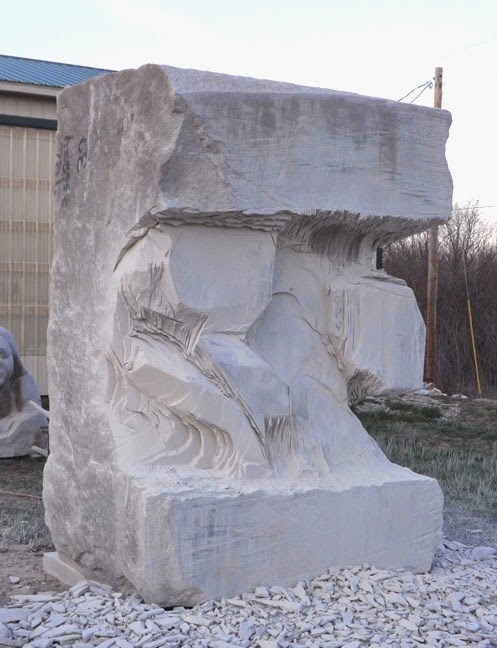
The sculpture looks really strange at this point, not at all like a lion, maybe some big bird.  I am cutting the stone in somewhat thin slices for removal as I am having some trouble with carpal tunnel (I am wearing a wrist brace) and it is bothered by too much force from the hammer I use to knock off sections of stone.  A thinner cut requires a lighter tap to remove.


It really looks like a bird from this angle.


I grind over the cuts I made into the stone so I can better "read" the sculpture.  The outline of the Lion is there but it is very flat at this point.  I will make measures from the model at well as sight-size to make sure of areas of stone that need to be removed.  Sight-sizing is holding up the model so that the model and sculpture are the same size to the eye and then comparing where different parts of the sculpture are and to see where stone needs to be removed.  A smaller model (12:1) helps in this as it is fairly easy to hold up, a 4:1 model can be difficult and cumbersome

I begin to form the head of the lion, grinding off corners and beginning to cut the planes of the head.  This is a technique I am most comfortable with as this is how I started carving stone - I would begin with the nose and work my way back into the stone.  I didn't have a great deal of strength then and had just begun using power tools so it was the easiest and safest way to create a sculpture.  It also takes the guesswork out of the carving - as you follow the form of the nose back everything else falls into place.

I have started to define the head (though it is on the large side am beginning to define the neck and shoulder.

I use a crayon to mark the area that needs to be removed to get back to the shoulder.

I have removed some of the stone from under the neck using a grinder then cut across it to get a clean surface.  Lots of stone needs to be removed from over the Lions neck..  The markings on the face show areas I need to remove and planes I need to strengthen.


I have used grinders to remove stone from over the lions head.  This is fairly difficult as I have to reach back into the stone as well work almost over my head - my arms get fatiqued quickly. 
The blocking of the piece (bulk stone removal) is almost complete and that is the most boring part of the job.  Now that the form of lion is emerging the work starts to get fun .


Friday, June 6, 2014

Beginning the blocking of the American Lion for University of Alaska Anchorage

I begin the sculpture by taking stone from the middle section of the block.  This is where the Lion will be located.  I use a large angle grinder and make slices in the stone cutting across the face of the block.  I am able to make a 3" deep cut with the diamond wheel, cutting the lower half of the block from ground level.  I will use a bench to cut the upper sections.  I am essentially slicing off sections of stone and while I can make a 3" deep cut, each slice needs to be no more than 2" as I will remove each slice by tapping it with an engineers hammer. 

Don has taken a picture of me on the bench making a cut in the stone.

And here I am after tapping off the slice of stone.  I try to move the stone away from the base of the block - I try, but ultimately end up with huge piles of stone that need to be carted away.

Here are the piles of stone I was referring to.  In this photo you can see I have begun to remove stone from the back of the block.

After several passes I am down to the outside dimensions of the Lion.  I draw on a simple outline of where I can safely remove stone.

Using the same slicing technique I remove area from under the tail of the big cat.

Using cross hatching and notes, I lay out areas that need to be removed and others that need to stay.  I stay well clear of vital areas - the foot and head - in case I need to make adjustments later.  This is a hold over from the days I used to carve direct into a stone (some of which was not the greatest quality) and would encounter a crystal pocket in the stone which would necessitate moving an entire section elsewhere (usually back into the stone.)

For removing areas under the chin I change directions, cutting into the block with the grinder.  I am also making the cuts very narrow so that the areas will break more cleanly.  I place a chisel between these cuts and tap them apart with my hammer.

I repeat the cutting technique descibed above in the area above the head and across the body of the cat.

The back leg (on left) and head are beginning to take shape.  Well, I can see it if no one else can.

This is a sculpture I am finishing up for this year's Yew Dell Sculpture show in Crestwood, KY.  She is entitled "Lifting the Veil" and is carved from Sylacauga Alabama Marble. 

Thursday, May 8, 2014

Limestone Block for the American Lion comes to the studio

I purchased the block for the American Lion from Indiana Limestone company.  Here it is - all 40,000 lbs of it- on a Stonebelt Freightlines truck which is out of Bloomington, Indiana.


At 40,000 lbs. this stone is a full load for this truck.


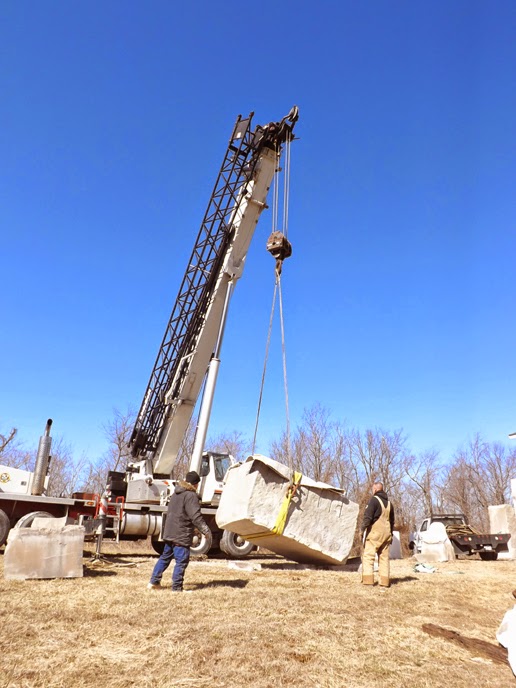
The crane operator and rigger from Padgett Cranes of New Albany, IN set up the block of the crane with a four part line.  These are metal cables and the set up - 2 part line, 4 part line will vary according to the what is being lifted and how much it weighs.   This is a seventy ton crane which is pretty big, but that is a big rock. 

This is looking up through the jib of the crane which is a way to extend it's reach.

The stone has been rigged up and is ready to be lifted. 


The stone comes off the truck and is set on the ground.


The stone then needs to be stood up on end.  A clevis is used to connect the nylon slings to wire cables which will give a lot more length.

The cables are fairly aggressive and can catch on the corners of the block so sections of carpet are placed under the nylon slings. 


The stone is then leveled.

Big block ready to carve....

and so the carving begins.  To watch this video follow this link
https://www.youtube.com/watch?v=JI7mt1YLKF4

Thursday, May 1, 2014

Lake Eola memories and a new project far north of Florida..

The stroll around Lake Eola affords many views of the Orlando skyline as well as lots of wildlife, such as this black swan.

I believe this striking bird is a anhinga or snake bird.  A diving bird, it pursues its prey underwater, but its wings become waterlogged and it is unable to fly.  It strikes this characteristic pose in order to dry it's wings.

A squirrel has found a snack is heady home with its treasure.

Live Oaks surround Lake Eola.  They're my favorite tree.

This is John Perrone and his wife Mary.  John is the manager at Lake Eola.  He was great to work with and made the job go much easier. 

I

Robert Petty and Lula Marshall also work at Lake Eola and I got to know them pretty well - I was there for days carving on the Muse and helping with the earthwork and plantings.  They were a lot of fun and a big help.  I got to know a number of people while I was at Lake Eola and everyone was really nice.  I have a special feeling for Lake Eola and everyone I met there.  It was like no other experience I've ever had.


I worked on the Muse for days and became acquainted with many locals who frequented the park.

This is a model of my next commission.  It is an American Lion  which existed during the ice age - it was the largest cat that ever lived. The sculpture wll be carved from a block of limestone measuring
9'H x 6'W x 4-6"D  weighing 20 tons.  This sculpture will take me far from my last sculpture installtion in Florida to....

Anchorage Alaska, at the University of Alaska Anchorage.  This is a photo of the site (the site is way over to the right side) was taken by the crane operator when he went out to look at where sculpture will be placed.